
AI-Focused MBA Barriers: The Real Reason You’re Postponing It
What causes professionals to delay starting an AI-focused MBA degree?
Working professionals postpone an AI-focused MBA due to acute time poverty, hyper-skepticism of traditional academic debt, and imposter syndrome regarding the technical barrier of entry.
Can we be real for a second? On any given Tuesday afternoon, thousands of ambitious, mid-career professionals hit what we call the "Promotion Wall." They watch an internal job posting go live, spot the brutal phrase "Master's Degree Required. No exceptions," and realize their decade of grinding is hitting a structural ceiling. They know they need an upgrade to survive the AI economy. Yet, they close the tab, sigh, and push the decision to "next year."
This isn’t procrastination. This is The Mobility Trap.
Driven professionals aren't delaying an AI MBA because they lack ambition; they’re freezing because they are trying to solve 2026 problems using bloated, 1996 academic logic. They are caught in a high-risk, low-reward cycle where they feel over-leveraged by existing debt, under-valued by employers, and accurately anxious about what rapid automation means for their paycheck. They feel the "Great Automation" breathing down their necks, causing a state of constant, low-grade professional anxiety.
If you’ve been waiting for the "perfect time" to pull the trigger on an AI-focused MBA, you are likely staring down five specific, high-stakes psychological and logistical anchors. Let's break down the data behind why you are stuck—and how to dismantle these barriers entirely so you can build true career sovereignty.
5 Common AI-Focused MBA Barriers Mapped to Practical Solutions
1. The Time-Poverty Wall
The traditional academic system assumes you have a "student lifestyle"—meaning you have open blocks of 4-hour windows to sit through lectures and participate in group projects. But you’re already grinding 40 to 60 hours a week, navigating a chaotic inbox, and trying to maintain a baseline human existence. When you evaluate the standard MBA time commitment, it feels like a fast track to burnout. If the path to career protection requires sitting on mandatory Zoom calls at 6:00 PM, you’re out. YES, that's the reality.
The Reality Check: You don’t lack time; you are suffering from a logistical mismatch between your life’s reality and rigid academic delivery formats.
The Modern Solution: Shift from "Time-in-Seat" requirements to an asynchronous, micro-learning calendar. Look for programs utilizing liquid schedules that let you consume high-impact modules in short, execution-focused bursts—during a commute, on a lunch break, or after the world shuts down for the night. You need to win your Monday morning back, not lose your entire weekend to group projects with people who don't share your work ethic.
2. The Financial Trauma & Double-Down Risk
Let's spill the tea: many professionals are already carrying undergraduate student loan debt. Spending another $60,000 to $100,000 on a legacy "prestige degree" feels like placing a blind gamble on a losing hand. The fear is explicit: If I spend this money and don’t get an immediate raise, I’ve actively made my family's financial situation worse. You are hyper-skeptical of traditional higher education, and honestly, you should be. It has evolved into a luxury gamble.
The Reality Check: Higher education shouldn't require a second mortgage. High-interest debt erodes your net worth and paralyzes your upward mobility.
The Modern Solution: Demand radical affordability. The game has changed from upfront five-figure bills to a clean, transparent subscription model—like Newstate U's flat-rate $300-a-month tuition. You pay only for the months you need, kill the predatory interest rates, and build a sustainable financial safety net while you learn.
3. The Tech-Shift & Obsolescence Anxiety
AI moves at a terrifying pace. A major reason professionals hesitate and fall victim to AI-focused MBA barriers is the fear of skills rot. They think, "If I spend two years learning a specific technical workflow, won't the software be so smart it doesn't even need that skill by the time I graduate?"
The Reality Check: If you are only learning shallow, tactical tools, you will become obsolete. If you learn systems orchestration, you become irreplaceable.
The Modern Solution: Fired up? You should be, because the trick is focusing on a curriculum engineered around competency-based intelligence and natural language orchestration. You don't need to learn deep Python coding; you need to learn how to act as a Choreographer of the System—directing tools, managing AI agents, and auditing business workflows for automation.
4. The "Imposter Gap" Cognitive Barrier
There is a lingering, toxic assumption that artificial intelligence is exclusively for math geniuses and developers. Professionals look at the fast-moving AI landscape and suffer from intense imposter syndrome, convincing themselves they "aren't tech-savvy enough" to command these systems. They assume they will fail the entry requirements or get drowned in code.
The Reality Check: AI is the very first technology where the coding syntax is simply plain English. Your human judgment and real-world domain background are far more valuable than a computer science degree.
The Modern Solution: Look for an institution that values your experience-as-currency through Competency-Based Education (CBE). Instead of forcing you to start from zero, your real-world background should be verified through practical certifications and converted into literal academic credit. This proves you’re already halfway to the finish line before you even open module one. Obsessed with efficiency? This is how you achieve it.
5. The Opportunity Cost Trap
Taking a career break to pursue full-time education means losing your salary, halting your professional momentum, and disconnecting from the workforce for 12 to 24 months. In an unpredictable market shifting under the weight of automation, stepping out of the arena is a luxury gamble you cannot afford. When calculating the total career impact and opportunity cost, the math simply doesn't add up for traditional paths.
The Reality Check: You shouldn’t have to choose between a paycheck and career progression.
The Modern Solution: Leverage stackable credentials. Start with a low-friction, high-velocity micro-course designed to solve a problem on your desk by 9:00 AM Monday morning. That win should be immediately locked in as a literal down payment on your full Master's degree, allowing you to scale up to an MBAi dynamically without ever pausing your current income stream or sacrificing your work-life-study balance.
What challenges do working professionals face with traditional MBA degrees?
Traditional MBAs fail working professionals by enforcing rigid 16-week calendars, charging bloated tuition fees, and teaching outdated, theoretical business models.
Let’s be blunt: legacy business schools are structured for an era that no longer exists. They are built around the gatekeeping of application cycles, registrar delays, and physical architecture. When a modern leader encounters these institutions, they run directly into the core MBA challenges for working professionals.
To optimize your search visibility and understand exactly why the traditional system is broken, let’s look at the operational mechanics of traditional higher ed versus modern, decentralized learning systems:
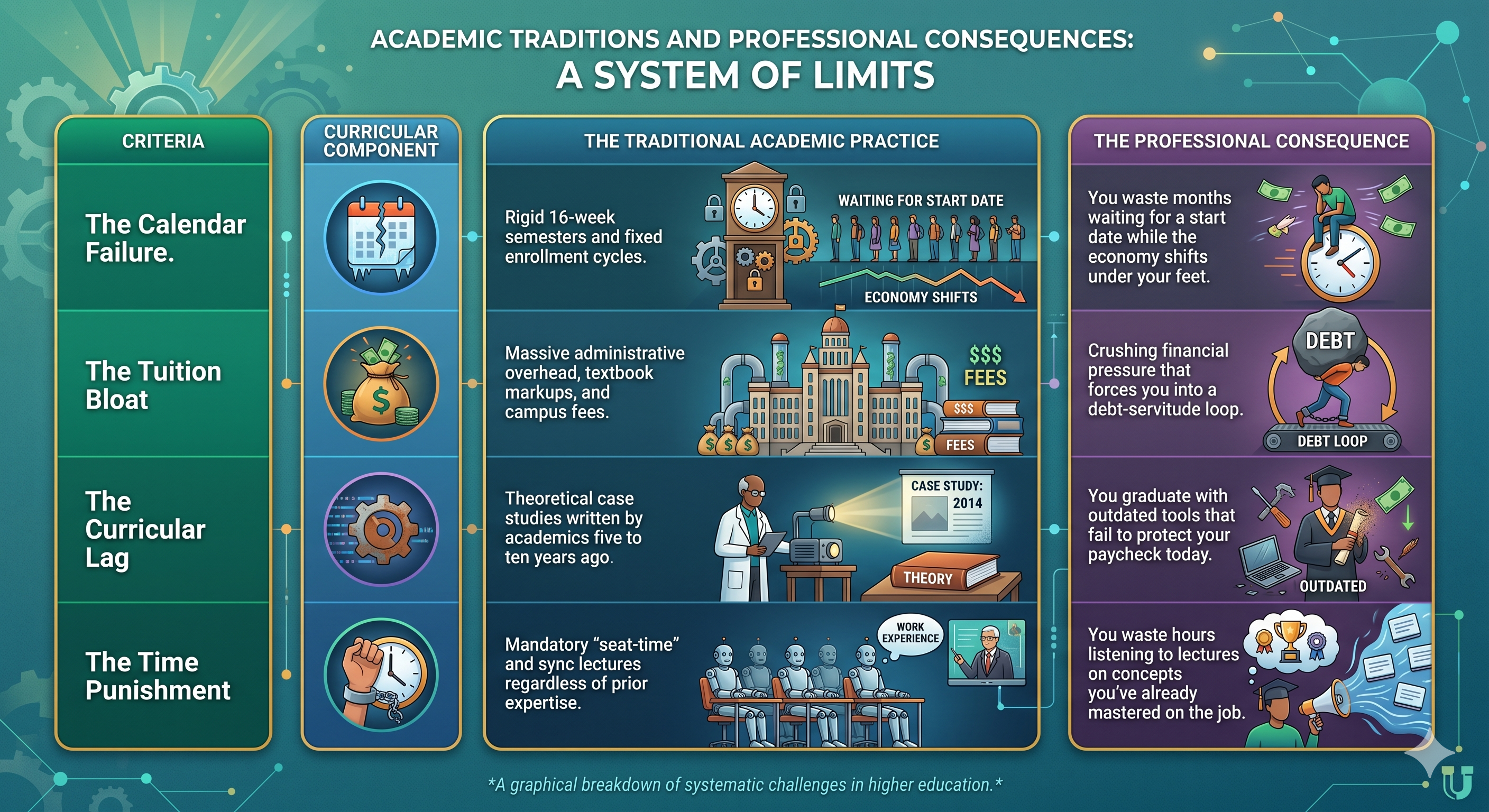
Traditional institutions treat your time like an infinite resource and your wallet like a bottomless pit. They reward you with deep debt and abstract theories, leaving you to return to work on Monday morning with zero actionable skills to show for a massive expenditure of effort.
In a world where basic tech proficiency is now a baseline expectation for management roles rather than a differentiator, a traditional, slow-moving degree is no longer safe—it's an operational risk. True MBA program flexibility isn't just an option; it's a defensive requirement for your career.
Take Ownership of Your Career Sovereignty Today
Stop following the rapid AI shift and start commanding it. You are over-experienced, under-credentialed, and accurately anxious about what the next technological updates mean for your job security. Do not wait for a corporate reorganization or an HR memo to realize your skill stack has depreciated.
At Newstate University, we built the nation’s first AI-founded, AI-focused, and fully accredited subscription degree designed explicitly for the modern builder. No application wait times, no academic gatekeepers, and no soul-crushing student loans.
We don't do boring lectures. We don't do ivory-tower theories. We build linchpins who know how to deploy technology to drive revenue.
Apply Now at NewstateU.com: Future-proof your paycheck, unlock your economic escape hatch, and master the exact skills the modern workforce demands. Let’s go to work.
